The message buzzed in my pocket while I was up on a scaffold, hands covered in plaster dust, trying to get the crown molding to sit flush against a hundred-and-forty-year-old ceiling. Claire. Ten years of silence, and then her name just pops up on the screen like a ghost you forgot you’d invited to dinner. I climbed down, dusted off on my jeans, and opened it. Three sentences. "Lena, we need to talk. Can I come by tonight? It's important."
I stared at the phone long enough for the screen to go dark. Then I stuck it back in my pocket, picked up my trowel, and got back to work. Whatever Claire wanted, it could wait until I finished this section of ceiling. My sister had already taken enough of my time, in one way or another. She wasn’t getting another minute until I was good and ready.
To understand why those three sentences felt like a bucket of ice water, you have to go back to a sticky August night eleven years ago. I was twenty-five, living in a one-bedroom walk-up in Savannah, and engaged to a man named Brooks. Brooks was a restaurant manager—easy smile, easy laugh, the kind of guy who remembered your coffee order on the second date and never forgot it after. We’d been together four years, and the wedding was set for October. The invitations were in a box on my kitchen table, stamped and addressed. I’d licked every single envelope myself.
Claire is my older sister by two years. She was the one who walked into every room like a spotlight had been waiting just for her. Big laugh, big plans, big opinions on everyone else's small life. When we were kids, she used to practice her autograph on the back of my notebooks. I was the quiet one, the one who could walk through a party and have no one remember I was there. My world was smaller, but it was mine. I was an architectural conservator—a glorified term for someone who fixes up old buildings and refuses to let them die. I could look at a crumbling fireplace surround from 1876 and see exactly what it needed. Brooks used to say I had old-house eyes.
Claire never understood it. "Playing with plaster," she called it. "When are you going to get a real business card?"
I found out about her and Brooks from a friend of a friend. Someone had seen them together at a hotel bar in Atlanta, where Claire was supposedly on a work trip and Brooks was supposedly visiting his brother. The news hit me square in the chest while I was assessing water damage in a Greek Revival on Jones Street. I remember putting my moisture meter down on the heart-pine floor and just standing there, listening to the house settle around me, a hundred and sixty years of creaks and groans, and I felt like I was one of them—something solid that had just discovered a fatal crack.
Brooks called that night. He said things. "Didn't mean for it to happen." "You and I were already… you know." I didn't know. I'd been addressing wedding invitations. I listened until he ran out of words, and then I said, "Alright," and hung up. Just that. Alright. I packed up the invitations that night and put them in the back of my closet. I never sent a single one.
Claire called a week later. She dove right in, no shallow end. She and Brooks were going to give it a real shot, and she hoped I could be happy for them, and by the way, they were thinking a spring wedding, and she really, really wanted me to be there because, after all, we were sisters, and sisters forgive each other. I let the silence hang on the line for a solid five seconds. Then I said, "No, you're not," and I set the phone down gently on the counter. I didn't slam it. I didn't want to give her the satisfaction of breaking anything else of mine.
I didn't go to the spring wedding. I was in Macon, hanging wallpaper in a 1920s bungalow for a client named Mrs. Albright, who paid me in cash and homemade lemon bars. My mother called me six times in the month leading up to it. "She's your sister, Lena Marie. Blood is blood." Blood, I learned that year, is just a biological fact. It's not a contract.
A few months after what would have been my own wedding day, I met Eli. He owned a salvage yard outside of town—four acres of reclaimed doors, mantels, clawfoot tubs, and heart-pine beams, all organized like a library. I went looking for a specific doorknob and found a man who could name the building and the decade of every piece of hardware in his inventory. He had iron-dust in his knuckles and an encyclopedic knowledge of Victorian millwork. On our third date, he took me to see an abandoned train depot he was trying to save from demolition. I looked at the sagging roof and the rotted sills, and I saw a masterpiece. He looked at my face and said, "You see it too." We got married at that depot two years later, after we'd brought it back to life. We held the reception in the main waiting room, under the restored tin ceiling, with forty of our closest friends.
My mother told me later that Claire referred to my new life as my "little salvage phase." A phase. While I was pulling permits and managing crews and bringing dead buildings back from the grave, Claire and Brooks were busy buying a "fabulous" mid-century ranch in the suburbs that needed, in Claire's words, "a total gut to the studs." I knew this, again, through my mother. A direct line of information I never asked for.
Here's the thing about that ranch. A year into their renovation, after they'd ripped out everything and realized they were in over their heads, my mother had an idea. "Lena, you have such a gift. They just need a little guidance. For family." I was thirty by then, my business was finally gaining real traction, and I'd recently learned a new word: no. But when my mother's voice gets that pleading, quavering edge, I still haven't built a wall strong enough to keep it out. I agreed to help. Just a consultation, I told myself. A weekend.
A weekend turned into eight months. I drew up a full gut-renovation plan. I sourced reclaimed windows that matched the architectural period. I found a salvaged front door that cost more to ship than to buy. I spent every other Saturday at that house, up on a ladder, covered in dust, showing their contractor how to repair the original plaster instead of ripping it out for drywall. I did it all for free. "For family." My mother's favorite currency. Claire would breeze through sometimes, holding a latte, and say things like, "That's coming along, I guess," before disappearing for a manicure.
At some point during month six, I sat down with my calculator. I tallied up the hours, the mileage, the sourcing fees, the consultations. I priced it all out at my standard rate. The total came to just over forty-two thousand dollars. I stared at that number for a long time. Then I closed the calculator, finished my coffee, and kept working. I never sent an invoice. I just wanted to know what I was giving away.
When the renovation was finally "done enough," Claire threw a housewarming party. Eli and I weren't invited. My mother mentioned it in passing a week later, and when she saw my face, she got flustered and said something about it being "just a small thing." I changed the subject. A few months after that, my mother called with another brilliant plan. Claire and Brooks had run out of steam—and money—on the back addition. Would I come and do a second phase? I said yes. I'd just be sending a contract first, at my full rate, fifty percent down. My mother's silence on the phone was a physical thing, heavy and cold. Claire, I heard through the grapevine, was furious. Said I'd gotten greedy. Said my "little salvage phase" had gone to my head. That was the last time my name passed between us. Seven years ago.
The silence that followed was peaceful. My business grew. Eli and I bought an old firehouse on the edge of the historic district and converted it into a live-work space—our apartment upstairs, my studio and his salvage showroom downstairs. We pulled the old brass fire pole out ourselves and polished it. It's in our living room now. I have shelves full of leather-bound project binders, each one a building I saved. A church in Thomasville. A library in Valdosta. The prize-winning restoration of a Civil War-era hospital that got a full-page feature in *Southern Living*. My mother still called, but she'd learned which topics were off-limits. Our conversations were a demilitarized zone.
Which brings me back to that message. *Can I come by tonight? It's important.*
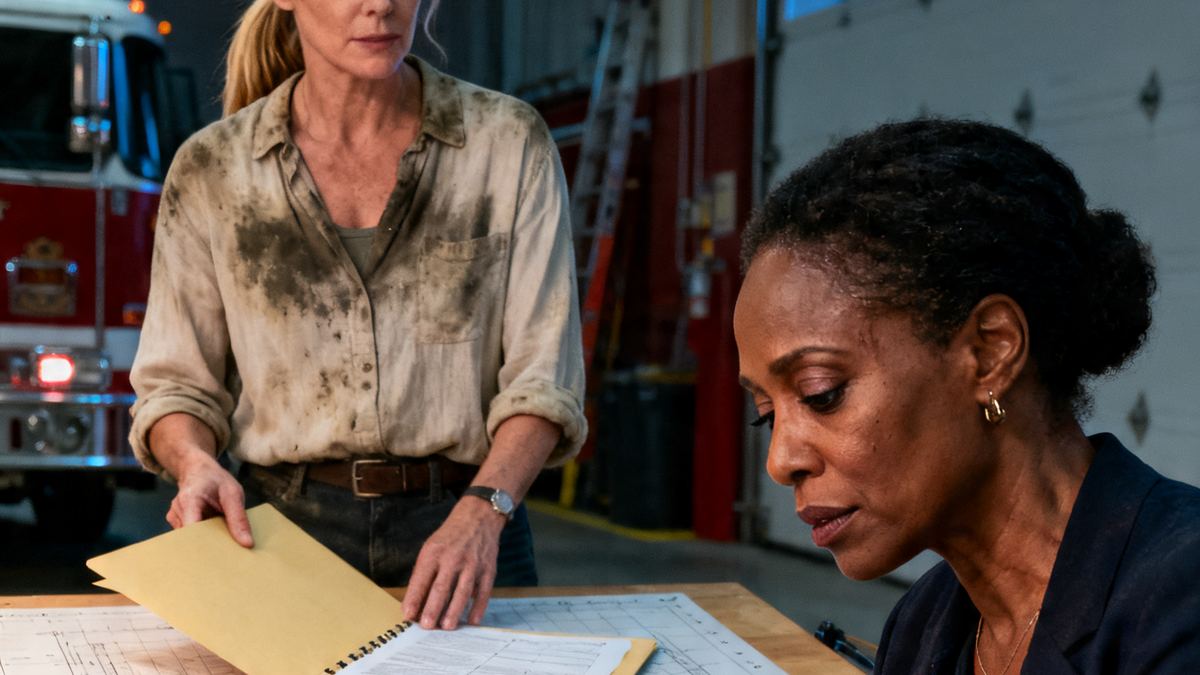
Claire arrived at six-fifteen. I opened the heavy steel door of the firehouse, and the first thing she did was look past me, her eyes doing a slow, appraising scan of the space. The soaring ceilings. The exposed brick. The massive arched windows and the polished concrete floors. I was still in my work clothes—jeans with a tear in the knee, a linen shirt with the sleeves rolled up, my hair escaping its ponytail and dusted with a fine grit from a marble repair job I’d been working on earlier.
"Wow," she said, stepping inside. Not hello. Not it's been so long. "Wow. You really did all this?"
"This is the studio," I said, gesturing. "Eli's in the back, cataloging some new doorknobs." I led her to my office area, a corner with a massive drafting table, a Mac desktop, and those floor-to-ceiling shelves of project binders. She walked over to them, running a manicured finger along the spines. Her own house, I noticed, was hanging on her frame a little loosely. Her designer bag was a season or two old, and the leather on her boots was cracking at the ankle.
"This is… a lot of projects," she said, a strange tightness in her voice.
"We stay busy," I said, taking a seat on a rolling stool. I didn't offer her coffee. She sat down in a client chair across from me, clutching her bag in her lap with both hands. The body language of a woman about to ask for something she has no right to.
We did the small-talk dance for a minute. The weather. Mom’s new knee. Her son, my nephew, who I’d never met. He was eight now. Then she took a breath and the preamble was over.
"Lena, look," she said, her voice dropping half an octave, getting conspiratorial. "We've hit a really rough patch. Brooks’ restaurant folded during the pandemic and never really bounced back. The house… we took out a second mortgage for that addition we never finished, and the bank is breathing down our necks. I'm not going to lie to you, it's bad." She looked me straight in the eye. "We need fifty thousand dollars. Just a loan, to stop the bleeding. We'll pay you back with interest. I swear." She said the last part with the same conviction she’d used eleven years ago when she’d sworn she never meant to fall in love with my fiancé.
I held her gaze for a moment, then stood up, my stool rolling back silently on the concrete floor. I walked to a row of vintage flat files against the wall, pulled open a deep bottom drawer, and retrieved an old, unmarked manila folder. The paper was starting to yellow at the edges. I’d kept it all these years, not out of spite, exactly, but as a reminder. A piece of evidence.
I laid the folder on the drafting table between us and flipped it open. Inside was a multi-page spreadsheet I'd printed out a lifetime ago. Every date I'd worked on her house. Every hour. Every salvaged doorknob, every foot of custom-milled trim, every consultation with their useless contractor. The final cell at the bottom was highlighted in yellow.
"You came here to talk about money," I said, my voice calm, even. "So let's talk about money." I spun the spreadsheet around so she could read it. "This is an invoice for the eight months of work I did on your first renovation. Design, sourcing, on-site labor, project management. At my rate from ten years ago. The total is forty-two thousand, three hundred and seventy-five dollars."
Her eyes flicked down to the number and then back up to me, her face flushing. "What is this?"
"That's the cost of the favor you never paid for," I said. "The one you called my 'little salvage phase.'" I tapped the number with my forefinger. "You want to borrow fifty. I want you to first acknowledge a debt of forty-two. Let's settle one family loan before we open another."
I saw the shift happen behind her eyes. The mask of the desperate sister melted away, and underneath it was the Claire I knew. Hard. Entitled. Furious. She stood up so fast the client chair skidded back and almost tipped over.
"Are you actually serious right now, Lena? That was a decade ago! That was you helping your sister, not a business transaction. You're going to dig up some ancient spreadsheet to throw in my face when I'm telling you I'm about to lose my house?"
"I'm not throwing it in your face," I said, my voice still level, quiet. "I'm just placing it next to your request. You want fifty thousand dollars from me. I'm simply reminding you that our history with money and favors is a little… complicated. You see a blank check. I see a forty-two-thousand-dollar hole in the ledger."
Claire’s hands were shaking. She snatched her bag off the floor and hugged it to her chest. "You know what your problem is? You've never been able to let anything go. You just sit here in your perfect little kingdom, polishing your awards, and you think you're better than everyone. You're a cold, transactional person, you know that? Mom was right."
That almost landed. Almost. But I had eleven years of practice. I simply nodded.
"You might be right," I said. "I do like transactions. They're clear. They're honest. You give something, you get something. Nobody gets confused, and nobody gets blindsided in a hotel bar in Atlanta."
The air in the room went solid. Her face lost its color. She just stared at me, her mouth a tight, thin line, the past hanging between us like a bad smell. She didn't have a comeback for that. There was no comeback. Without another word, she turned on her cracked-leather heel and walked towards the big steel door, her footsteps echoing in the vast space.
"Oh, and Claire?" I called out, just as her hand touched the handle. She froze, her back to me. "If you decide to take me up on my offer—to settle that outstanding invoice—we can talk about a bridge loan. At five percent interest. The paperwork's ready whenever you are."
She didn't turn around. The big metal door groaned open and then clanged shut, the sound reverberating through the firehouse like a bell. I stood there in the silence, looking at the old folder on my drafting table. Then I walked over, closed it, and slid it back into the bottom drawer of the flat file. Eli materialized from the back, wiping his hands on a rag, a question in his eyes. I just walked over to him and leaned my head against his chest, the rough cotton of his shirt smelling like sawdust and iron. He put his arms around me and didn't say a word. He didn't need to. The old building creaked gently around us, a sound I'd learned to hear not as a complaint, but as a comfort. It was still standing, and so was I.