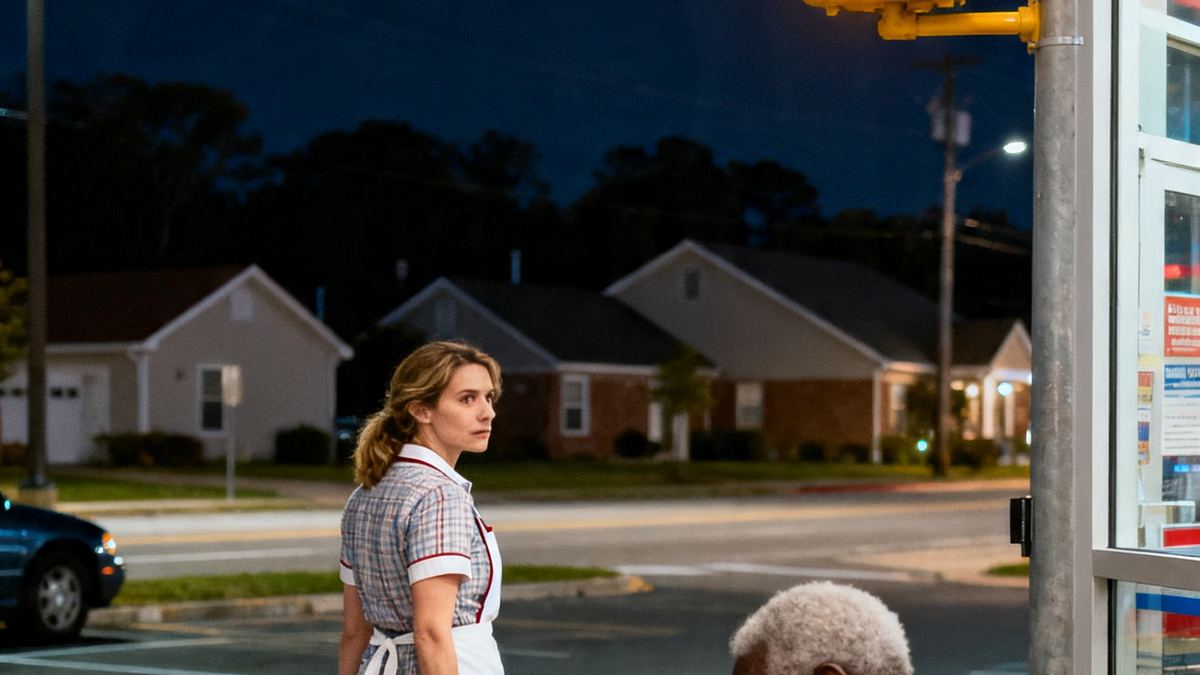
I almost kept walking.
It was Tuesday, a little after nine, the parking lot lights buzzing and flickering over the wet asphalt. I’d just finished a double at the diner and my feet were screaming. I just needed milk, eggs, maybe one of those discount rotisserie chickens before they ran out.
He was on the bench by the cart return. Old man in a faded canvas jacket, hands resting on his knees. Not holding a sign, not looking at anyone. Just staring at the traffic light blinking yellow down on Division Street. Something made me stop. Not pity—something quieter, like a voice in my ribs I hadn’t heard in a while.
I walked over.
“Hey. You want me to grab you anything inside?”
He flinched, then smiled. The kind of smile that’s mostly embarrassment.
“Oh, honey, no. I’m fine. Just waiting.”
“Waiting for someone?”
He looked at his hands for a long moment. “I’m not entirely sure anymore.”
I stood there like an idiot for about five seconds. Then I went in, grabbed my chicken, and walked straight back to the bakery. Bought a warm apple pie, the kind they box up straight from the oven, along with a loaf of bread and a carton of soup from the deli. On my way out I set the bag next to him on the bench.
He stared at it like it was a letter from another life.
“Thank you,” he said. “Not for the food. For talking to me.”
I sat down.
His name was Walter. Walter Keene. Seventy-eight. His wife had died four years ago—aneurysm by the sink while she was watering her African violets. His daughter lived in Austin, called every Sunday, but hadn’t been up to Portland in over a year. He didn’t say it with anger. Just with the weight of a man who’d gotten used to waking up to silence.
That night we talked for almost an hour. Before I left, I scribbled my number on the back of a receipt and pressed it into his hand.
“If you ever need anything, call. Seriously.”
I was sure he never would.
Two days later my phone buzzed during a lunch rush. I almost didn’t pick up.
“Is this… is this Sarah? From the bench?” His voice was so quiet I could barely hear him over the fryers.
“Yeah, Walter. What’s up?”
“I hate to ask. The bulb in my hallway went out. I can’t get up on the stepstool anymore.”
I went over after my shift. The apartment smelled like cedar and old newspapers. I changed the bulb. Then I noticed the faucet in the kitchenette leaking, so I called my buddy Mike who does plumbing on the side. Walter tried to pay me with a ten-dollar bill that looked like it had been through the wash three times. I refused.
That’s how it started.
Every Wednesday I’d bring him groceries. Sometimes we’d just sit at his little Formica table, drinking tea he insisted on making loose-leaf, listening to the rain. He’d pull out faded Kodachromes from a shoebox: his wife, Helen, in a yellow dress on the Oregon coast, their daughter with a missing front tooth holding up a trout, Walter himself young and handsome outside the high school where he’d taught history for thirty-two years.
One Wednesday he said, “You know, Sarah, I don’t wait for presents anymore. But God, do I wait for that knock on the door.”
I’d laugh. But I could feel it. That sound had become the center of his week.
About four months in, I got the flu. Not the polite kind—the kind where you’re convinced your bones are trying to leave your body. Fever of a hundred and three. I lived alone in a studio off 82nd, and by day three I was just a lump under a blanket, listening to my phone buzz with texts I couldn’t answer.
Around seven that evening, someone knocked.
Not a gentle rap. Three solid thumps.
I shuffled to the door, wrapped in my comforter. Walter stood in the hallway, one hand on his walker, the other gripping the arm of his neighbor, a big man in a Seahawks hoodie. The neighbor was holding two grocery bags.
“I’d have carried them myself,” Walter said, “but I figured I couldn’t make it up your stairs without reinforcements.”
The bags were full. Chicken broth, lemons, NyQuil, honey, a sleeve of Saltines, fresh ginger, a box of tea. And at the bottom, still warm, a small container of soup from the same deli counter where I’d bought him that first pie.
“How did you even know I was sick?”
He tilted his head. “You didn’t come Wednesday. Didn’t call. You’ve never missed a Wednesday.”
I started to say something, but my throat closed up. They came in. Walter’s neighbor, whose name turned out to be Lou, took out my trash and wiped down my kitchen counters while Walter made me eat spoonful after spoonful of broth, watching me like a hawk every time I coughed.
When I was upright again, Walter came by one last time before I went back to work. He sat in my one good chair, folded his hands over his cane, and said something I still think about more than I should.
“Folks think they’re helping old people. But they’re really helping themselves. Kindness doesn’t go one direction. It circles back. Always finds the road home.”
I told him that sounded like something a history teacher would say. He laughed until he coughed, and then I made him tea.
Two years later, on a cold April morning, I got a call from a number I didn’t know. It was his daughter, Grace. She’d found my number in his wallet, tucked behind a receipt from six years ago that he’d never thrown away.
Walter had passed in his sleep the night before.
I hung up and sat on my floor for a long time.
Now, every April eighth, I stop at the same Kroger on Division. I buy a warm apple pie. And I sit on that bench by the cart return, with the parking lot lights flickering to life overhead. I don’t say anything. I don’t check my phone. I just sit there, watching the traffic light blink yellow, and I wait.