The first six years I lived in Brooklyn, I didn’t know my next-door neighbor’s name. Not her first, not her last. We shared a wall in a creaky pre-war building on Union Street. We’d trade half-smiles at the mailboxes. I’d hold the lobby door if she was behind me. She’d nod. I’d nod back. That was the extent of it. I figured she was somewhere in her late sixties. Rode the same green bicycle to the market every Wednesday. Wore the same tan coat when the weather turned. Her apartment number was 4C. To me, that’s all she was.
Her name was Edna Kaplan. I learned that on a Thursday in October when my body decided to fall apart.
It hit me out of nowhere. One morning I woke up and the room tilted sideways. Vertigo so violent I had to crawl to the bathroom. By noon the fever spiked to 102. My joints ached like someone had worked me over with a pipe. I couldn’t keep water down. Couldn’t hold my phone steady enough to type. My sister was in Phoenix. My so-called work friends were five boroughs away and busy with their own messes. I convinced myself it was just a bad flu. Two days in bed, tops. I didn’t tell a soul.
Day three, I stopped being able to stand.
That afternoon, a knock at my door. Three firm taps. I didn’t answer. I physically couldn’t. Then a voice through the wood, thin but steady.
“Hello? It’s your neighbor. 4C. I haven’t seen you in a few days. Your mail is piling up. Just want to know you’re okay.”
I croaked something. Must have sounded awful, because thirty seconds later I heard a key in the lock. Still don’t know how she got my spare. Maybe the super. Maybe she just asked. The door swung open and there she was—tan coat, white hair pinned tight, a canvas tote dangling from her wrist. She took one look at me slumped against the hallway wall and her face did something I still can’t fully describe. Not pity. Not panic. Just this quiet, bone-deep recognition. Like she’d been waiting for this moment for years.
“Alright, sweetheart. Let’s get you back to bed. I’ll take it from here.”
She didn’t ask permission. Didn’t need it. She guided me to the bedroom, propped up my pillows, took my temperature with a thermometer she pulled from her own bag. Then she disappeared into my kitchen and I heard water running, cabinets opening, the soft clink of dishes.
I drifted in and out. Every time I surfaced, something had changed. A glass of ginger ale on the nightstand. A damp washcloth folded across my forehead. A small pharmacy of Tylenol and Pedialyte arranged within reach. At one point I woke to the smell of chicken broth. Real broth, not the canned stuff. I cried a little, I think. The fever made everything strange.
She came back every single day for a week. Always in the late afternoon, right when the light through my window went gold. She’d check my temperature. Refill my water. Push a bowl of soup into my hands and watch until I finished it. She moved through my apartment like someone who’d mapped it out ahead of time. Never prying. Never hovering. Just present. Once, half-delirious, I asked her why she was doing all this.
“Old business,” she said. And left it at that.
On the eighth morning, I woke up and the world had stopped spinning. I was weak but upright. Alive. I shuffled into the kitchen and that’s when I saw it.
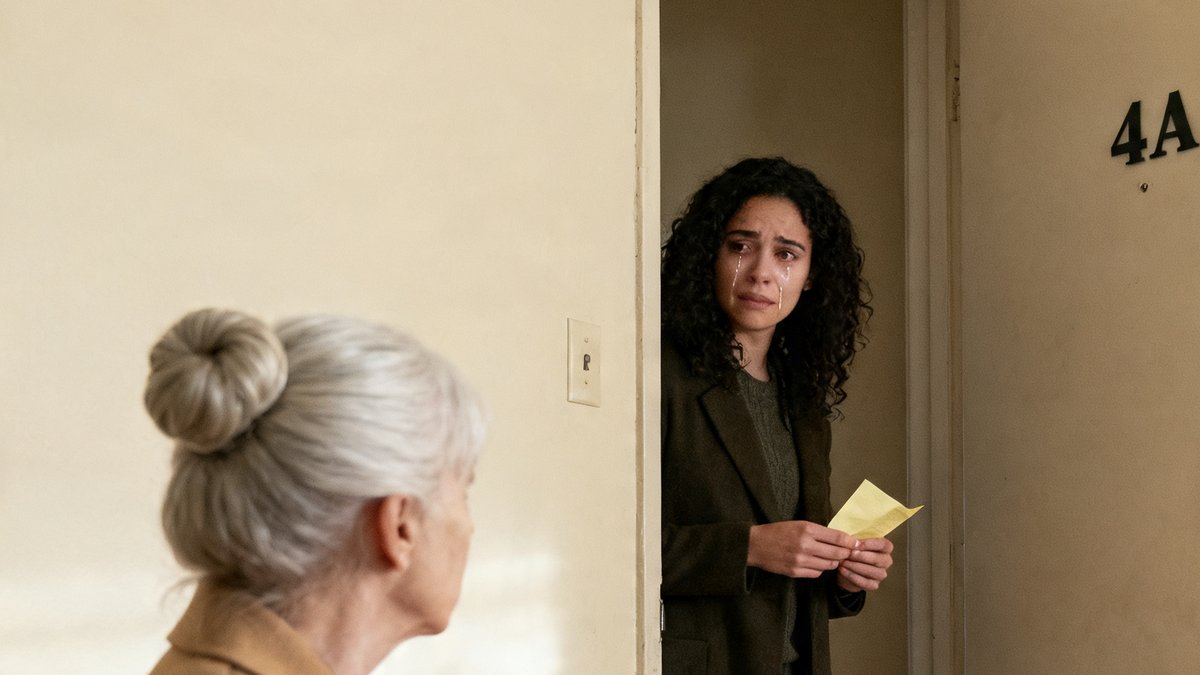
My counter was spotless. A mason jar of yellow tulips sat by the window. And pinned to the fridge by a tiny magnet shaped like a star was a folded scrap of lined paper, yellowed at the edges. The handwriting was careful, small, the ink slightly faded.
*Thank you for not walking past that night. I never forgot.*
I stared at it for a long time. Searched my memory and came up blank. What night? What had I done? I was twenty-nine years old, worked tax season at a mid-tier accounting firm, spent my free time rewatching bad reality TV. I wasn’t someone’s guardian angel. I barely remembered to water my own plants.
That afternoon, the knock came again. Edna stood in my doorway holding a Tupperware of matzo ball soup. She saw the note in my hand and something shifted in her face. She sighed, set the soup on the counter, and lowered herself onto my secondhand couch.
“You don’t remember,” she said. Not a question.
I shook my head.
She folded her hands in her lap. Told me she’d lived in this building for forty-one years. That twenty-two years ago, her husband Joseph died of a heart attack on the F train. That she’d been left with a mountain of medical debt, a mortgage she couldn’t afford, and a son in his first year at City College. That one December, things got so bad she went three days without eating so her boy could have enough.
“One night, I came home from a shift at the library and found a paper bag outside my door,” she said, her voice flat and even, like she was reading from a script. “Inside was rice. Canned vegetables. A box of tea. A carton of eggs. And an envelope with four hundred and sixty dollars in cash. No name. Just a note on this same paper.” She tapped the scrap in my hand.
I felt the floor drop out from under me.
“The note said, *Hold on. This passes. You’re not invisible.*”
And then, slowly, it came back. Fragments first. A night in my first year in the city. I was broke too, working two jobs, but I’d just gotten my holiday bonus—six hundred bucks. I’d overheard someone in the laundry room mention the old lady in 4C whose husband had died. How she was drowning. How nobody helped. I didn’t know her. Had never spoken to her. But something about it lodged in my chest and wouldn’t let go.
I went to the bodega. Bought what I could. Pulled the cash from the envelope my boss had handed me. Slipped it into the bag. Left it outside her door at two in the morning and ran down the stairwell like a thief in reverse. I was embarrassed. Not by the act, but by the awkwardness of it. The clumsy intrusion. I didn’t want credit. I just wanted her to eat.
And then I forgot. Completely. Filed it away and moved on with my life.
“You never said anything,” I whispered.
“Neither did you,” Edna said. “That was the whole point.”
She told me she spent years trying to figure out who left that bag. She suspected a few neighbors but could never prove it. Then three years later, she saw a handwritten flyer I’d taped in the lobby—selling a bookshelf before I moved upstairs from 2B to 4A. She recognized the loops on my lowercase G’s. The way I dotted an I off-center. She knew. But she waited. Waited for the right moment. Waited for a knock on the right door.
“When I didn’t see you come down for three days, I knew it was time,” she said. “You don’t get a chance like that often. To give back exactly what you were given.”
I sat down next to her. Didn’t know what to do with my hands. She reached over and took one of them. Her skin was cool and dry, knuckles swollen with age.
“You kept my note,” I said. “Twenty-two years.”
“You kept me alive,” she said. “Twenty-two years. Fair trade.”
We sat in the quiet for a minute. The radiator hissed. Outside, a garbage truck groaned its way down Union Street. Ordinary sounds. The world hadn’t changed. But something between apartments 4A and 4C had snapped into place like a lock turning.
That was three years ago. Edna turned seventy-two last March. I made her a cake she didn’t need and bought her tulips she pretended were a bother, and every Sunday we split a pot of coffee in whichever kitchen is tidier. She knows the code to my apartment. I have a key to hers. Last winter, when a pipe burst in her bathroom and sent water through my ceiling, we didn’t call the landlord right away. We stood in the flood together with towels and a bucket, laughing like idiots, because some things just don’t matter when you’re in the same boat.
Her son Jacob calls me now and then to check in. Calls me “the other daughter.” Edna’s health is solid but not forever—nothing is—and when that day comes, whenever it comes, I’ll be three steps across the hall. I’ll be the one knocking. I’ll be the one with the soup and the note.
Some people spend a lifetime looking for their purpose or their tribe or some grand sign they’re on the right path. Edna found hers in a paper bag outside a door in the dead of night. I found mine written on a twenty-two-year-old scrap of paper stuck to a fridge with a magnet shaped like a star. The whole thing makes me think maybe the universe isn’t chaotic at all. Maybe it just plants people three inches away and waits to see if you’ll turn your head.
I almost didn’t. I was twenty-three years old, rushing down a stairwell, embarrassed by my own kindness.
If you’re standing in a hallway right now, holding something someone needs, leave the bag. Don’t sign your name. Just knock and walk away.
And if you’re the one behind the door, and someone knocks when you can’t stand up anymore, let them in. They might be returning a debt you forgot you were owed.