Marcus decided to leave me on a Tuesday, right between the shrimp scampi and the seasonal fruit tart. We were at Maggiano’s, our usual spot in Oak Brook, the one with the dark leather booths and the waiter who always remembered to bring extra lemon for his water and never once bothered to learn my name.
He set down his fork with the solemnity of a man about to announce a corporate restructuring.
“I need to find myself, Claire. And Dr. Elise… she’s helping me do that.”
Dr. Elise. His life coach. A woman who wore nude stilettos sharp enough to puncture a yoga ball and spoke in a voice so aggressively serene it made airport gate announcements sound like death metal. He’d been seeing her for three months to work on his “executive mindset,” and apparently, her coaching involved a lot of après-session wine flights and the kind of deep eye contact that can convince a man who can’t operate his own air fryer that he’s a misunderstood visionary.
“I need to live for myself now,” he said. “I want to understand who I really am.”
I almost laughed. Who are you, Marcus? The man who texted me “where’s the soy sauce” from in front of the open pantry where it had lived on the second shelf, same spot, for fourteen years? The man who once stood in the electrical aisle of Home Depot for forty minutes because he couldn’t remember if the hallway light was a standard or candelabra base, even though he’d changed the bulb himself two weeks prior?
I didn’t laugh, though. I just sat there, a strange, cool stillness spreading through my chest. It wasn’t shock. It was the quiet that settles after years of exhaustion. A long marriage to Marcus was like living next to a highway; you stop hearing the individual engines, just a low, constant hum of weaponized incompetence and gentle neglect. The hum was finally stopping.
While he monologued about his journey and his truth in that half-whispered voice people use in documentaries, I was thinking about the actual, physical weight of his life I’d been carrying. I remembered hand-scrubbing his favorite vintage Rolling Stones t-shirt in the bathroom sink while on a work call, because the silk-screen would “crack in the machine.” I recalled the corporate dinners with his partners where I’d spend four hours debating school districts and golf handicaps, my smile plastered on so tight my jaw ached. I’d smile and nod while they talked about tax-loss harvesting, and I’d mentally rearrange the pantry by expiration date just to feel something.
“It’s not because of you,” he said, studying a spot on the wallpaper just over my left shoulder.
Of course it wasn’t. It was the siren song of frictionless validation from a woman whose professional credentials were framed next to a photo of her with a baby kangaroo at a wellness retreat. I wasn’t a problem to be solved anymore. I was just… the operating system. Stable, functional, unremarkable, and completely invisible.
“What will you even do now?” he asked, finally looking at me, a flicker of concern in his eyes, as if I were the one who’d just had the floor ripped out from under me.
I pulled my cardigan a little tighter, not for comfort, but like a warrior checking the straps on her armor. I took a long, slow sip of the Malbec he’d said was “too aggressive” for a weeknight.
“I’m going to do the one thing you’ve never been very good at, Marcus,” I said, my voice steadier than it had been in years.
The waiter swooped in, the seasonal fruit tart balanced on his palm.
“I’m actually going to start living.”
And then, the cleanest, most beautiful thing happened. He left. He actually just… left. He took his distressed leather messenger bag, his complicated, over-engineered German car, and the faint scent of a cologne he’d started wearing that was definitely not from Macy’s, and he walked out of the restaurant. He walked out of my life with the misplaced confidence of a man who thinks trading a library for a pop-up book is an upgrade.
I sat there in the booth, the silence ringing like a bell. The restaurant felt huge and full of air. The fruit tart sat between me and the empty chair, a perfect, golden little discus. I picked up my fork and ate the whole goddamn thing in four bites. I didn’t wait. I didn’t share. I just ate it, and the tang of the lemon curd was like tasting a new decade.
I went home to our condo in the West Loop, a place suddenly cavernous with the absence of his things. It wasn’t an emptiness, though. It felt more like an exhale after a held breath. I pulled the emergency bottle of Veuve Clicquot from the back of the fridge, a bottle we’d been saving for an occasion that never seemed grand enough for him. I popped the cork, and it sounded like a starting pistol. Getting out of a life that had orbited entirely around the gravitational pull of Marcus’s needs was, itself, a five-star occasion.
The next morning, I didn’t wake up. I *rose*. I booked an appointment at an intimidatingly hip salon in Wicker Park and let a woman with a silver buzzcut chop eight inches of hair off. It hit the floor in heavy, brown coils, and my head felt impossibly light. I went to the bank and moved half of our joint savings into a high-yield account that was just mine. On the walk home, I did something I’d wanted to do for six years: I went into the tiny, perpetually packed bakery on Division, the one with the line always out the door, and I bought a slice of sour cherry pie. Marcus hated cherries. Said they were too “unpredictable.”
That night, I ate the pie straight from the bakery box with a fork, cold. And I opened my laptop. I didn’t download a dating app out of desperation. It was more of a scientific inquiry, a field study to see if, at fifty-one, I was still a visible, viable woman in the world, or just a ghost who paid the electric bill. I uploaded a photo my sister took, where I’m laughing at something off-camera, the new short hair framing my face. Within an hour, my phone started buzzing with notifications that were, frankly, a bit shocking. I wasn’t a ghost. I was a beacon.
For three glorious months, I was on a roll. I took a ceramics class in Pilsen and got clay so deep under my nails the instructor said my hands looked like a real artist’s. I went to movies by myself on Saturday afternoons, eating all the popcorn before the previews were over. I stopped folding my underwear into perfect little squares. The silence in the condo transformed from a void into a deep, lush peace. My cat, Chairman Meow, who’d always been Marcus’s cat by default—tolerating him more than anyone else—suddenly became a lap-seeking missile, his purr a constant, rumbling engine of approval. I’d go to sleep with a book in one hand and the cat curled at my feet, no curlers, no five-year plan, a lightness in my chest that felt brand new. I’d found the beginning of a life with myself, and it was good.
But Marcus is a man who can’t remember a light bulb, and he also couldn’t remember what he’d thrown away.
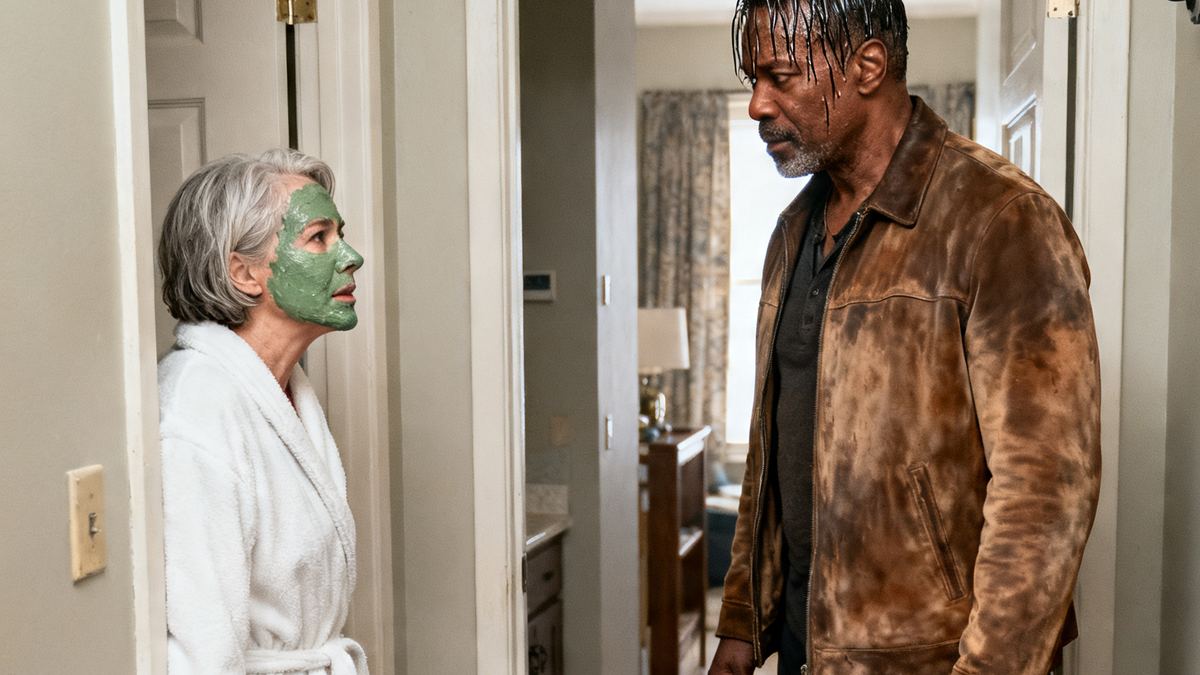
He came back on a Thursday, during a rainstorm that had turned the streets of the West Loop into black mirrors under the streetlights. The buzzer rang at 9:47 p.m. I wasn’t expecting anyone. I was on the couch in my robe, a green clay mask drying on my face, Chairman Meow a warm, vibrating loaf on my feet.
“It’s me,” his voice crackled through the intercom. I could already hear the rain pelting his expensive suede jacket. “I… I need to talk.”
The audacity was so pure, so perfectly Marcus, that curiosity rather than anger made me press the button to let him up. He stood in my doorway, dripping and hollowed out, looking thinner and somehow smaller. The cologne was gone, replaced by the sharp, metallic smell of rain and something else—anxiety, probably.
The fantasy had, predictably, curdled. Dr. Elise’s journey of self-discovery, it turned out, required a level of subsidization Marcus had not anticipated. Her “investment in their shared future” involved the down payment on a “holistic wellness cooperative” outside of Boulder. He’d liquidated a chunk of his retirement fund for it. She had taken the money, reconnected with an old flame at a sound-bath facilitator’s conference in Sedona, and sent Marcus a goodbye text that consisted entirely of a dove emoji and a broken heart.
“I’ve made a terrible mistake,” he said, a puddle forming around his Italian loafers on my hardwood floor. His eyes were red-rimmed, his hair plastered to his forehead. He looked like a golden retriever who’d been caught digging in the trash. “The silence at my place… it’s unbearable. There’s nothing there. It’s just… empty. I can’t live with the quiet. Please, Claire, can I come back?”
I leaned against the doorframe, and for the first time, I didn’t see the man I’d married. I saw a disheveled, middle-aged child who had mistaken novelty for happiness and was now asking the reliable, boring old operating system to reboot and save him. The hum of the highway was threatening to start up again. Chairman Meow, from his spot on the couch, lifted his head, gave a slow, deliberate blink, and then turned his back to the door.
It was the most profound advice I’d ever received.
I thought about the years of hand-washing t-shirts, the tax-loss hunting, the cherry-free existence. I thought about how light my head felt without all that hair, how delicious that entire, unshared movie popcorn was. I let the silence stretch out in the room, no longer a thing to be filled, but a deep, still pool of my own making.
“Marcus,” I said finally, my voice low and clear, cutting through the sound of the rain. “You can’t come back. This quiet? It isn’t empty for me. It’s full. And I am not trading it for the noise of your chaos ever again.”
“But I’m nothing without something to lean on,” he finally whimpered, a raw, unfiltered admission that hung in the air between us.
The rain hammered against the windows. I looked past him, at the dark, cleansing downpour.
“That’s the first true thing you’ve said in years.”
I closed the door softly. The click of the latch was the most definitive sound I’d ever heard.
I walked back to the couch, and Chairman Meow, as if to seal the deal, uncurled from his spot and stepped delicately onto my lap, kneading the soft terry cloth of my robe and purring like a tiny motorboat. The storm kept battering the windows, but inside, the air was still and warm. I pulled the half-empty bottle of Veuve Clicquot from the fridge door, poured the last of it into a juice glass, and looked at my reflection in the dark window—a woman with a green clay face, a short, wild haircut, and a cat on her lap.
I raised the glass to her.
“To the quiet,” I whispered, and it tasted like a whole damn cake.