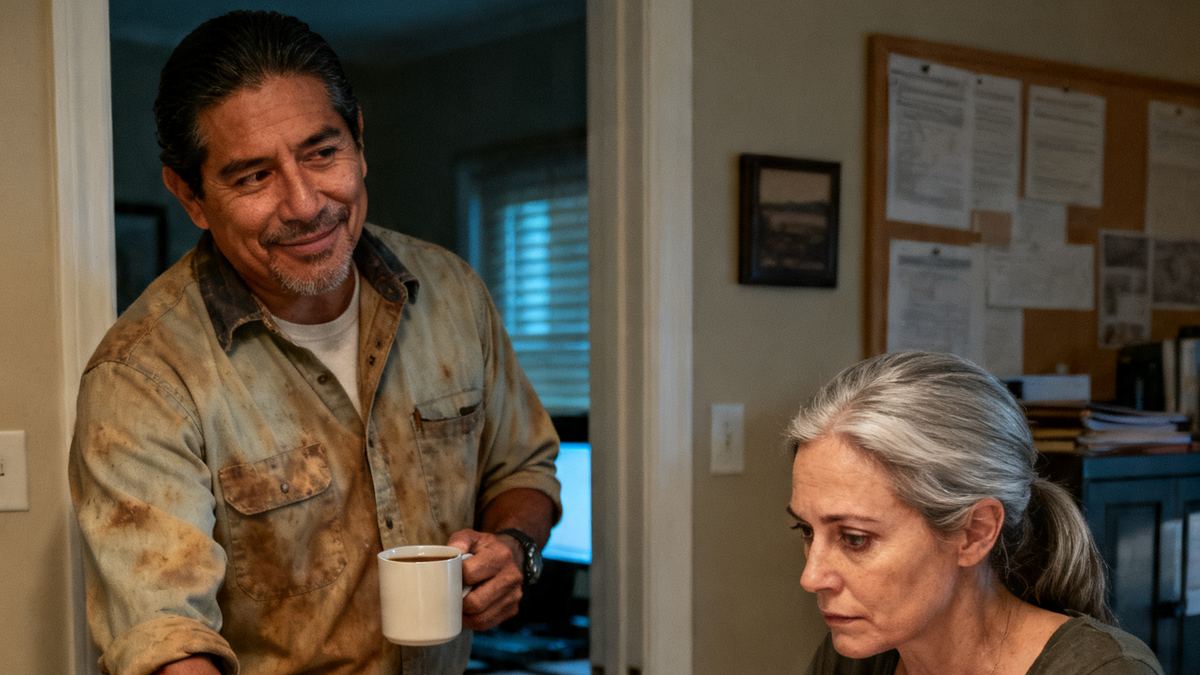
Linda sat in the folding chair of the county health clinic, her hands clenched around her purse like it might fly away. The doctor, a tired man with nicotine-stained fingers, flipped through her chart and then looked at her over his reading glasses. “I’m sorry, Mrs. Whitfield. There’s no easy way to say this. You won’t conceive. Not naturally, and not with any of the treatments we can offer here.” He said it like he was reading a weather report. Linda nodded, her throat suddenly full of dust. She walked out into the parking lot where the heat bounced off the asphalt and a stray dog limped past a rusty pickup. Her husband, Tom, was waiting in their old Ford, a ’78 F-150 with a rusted-out bed and a radio that only picked up AM. He saw her face and killed the ignition. “It’s a no, then,” he said. She could only nod. He pulled her into a hug, his work shirt smelling of grease and sweat. “Then we’ll find another way,” he mumbled into her hair.
That was seven years ago. Now, in March of 1995, Linda stood in the hallway of the Pine Ridge Children’s Home, a cinderblock building on the edge of town that smelled of floor wax and boiled potatoes. The social worker, a brisk woman with a clipboard, had already warned her: “The older ones are tough to place. They’ve been through a lot.” Linda had nodded, but her mind was somewhere else entirely. She walked into the common room, where a dozen kids were scattered across faded couches and plastic chairs. In one corner, a lanky boy about nine was using a stub of charcoal to draw on a flattened Corn Flakes box. He looked up when she approached, his gray eyes sharp and guarded. He didn’t smile. “You here for someone?” he asked, his voice already carrying the rough edges of a kid who’d learned not to expect much. Before Linda could answer, a small girl with tangled blonde hair and a boy clutching her hand shuffled closer. They were maybe five and three, with the same high cheekbones and wide, watchful eyes. The social worker whispered, “Siblings. Their mother’s rights were terminated last year. The older one, that’s Drew. He’s nine. No relation to the little ones.”
Drew shrugged. “I ain’t got nobody. These two, they’re Tina and Joey. They stick together.” Linda looked at the three of them, and something inside her—a crack she’d carried for years—shifted. She turned to the social worker and said, “I want to take them. All of them.” The social worker nearly dropped her pen. Tom, who had been standing near the door, took a half-step forward. “Linda… all three?” “Yes.” Her voice was quiet but solid, like a fence post driven into clay—won’t budge.
It took four months and nearly eight thousand dollars in legal fees, which meant a second mortgage on the farm, to push through the paperwork and home inspections. When the day came, Tom drove the three kids out to their little farmhouse on the outskirts of Culver’s Creek, a town where the only businesses still open were the diner, a small grocery, and the sawmill where Tom worked. The house was a hand-me-down from Tom’s folks—two bedrooms, a sagging porch, and a roof that leaked if you so much as looked at it sideways. Linda had scrubbed every surface, sewed new curtains from flour sacks, and set up a set of bunk beds she’d bought for thirty-five dollars at the Mennonite rummage sale.
The neighbors had plenty to say. Margaret Brewer stood at her fence, arms crossed, her mouth twisted like she’d bitten a lemon. “Linda, are you out of your mind? Three orphaned kids you don’t even know? They’ll drain every penny you’ve got and then run off the minute they’re grown.” Her husband, Carl, snorted from his tractor. “You can’t make a family out of charity cases. You’ll see.” Linda just smiled tightly and led Drew, Tina, and Joey into their new home.
That first night, Drew sat rigid on his mattress, staring at the ceiling. “You gonna send us back if we’re bad?” he asked, his voice flat. “No,” Linda said, sitting on the edge of his bed. “What if I fight? I fight a lot.” “Then we’ll deal with it together. But you’ll never be sent away.” He was silent for a long time. Finally, he whispered, “Okay. I’ll stay.”
But staying didn’t come easy. A week later, Drew’s bed was empty at dawn. Linda called the sheriff, but she herself drove the old Ford to every spot a kid might hide—the abandoned grain silo, the railroad depot, the creek. She found him at Miller’s Bridge, sitting on the edge, throwing stones into the muddy water. She sat down beside him, her breathing rough, and didn’t say a word. For a long while, only the plunk of stones broke the silence. Then Drew said, “I figured you’d be happier without the extra mouth.” Linda pulled a pack of saltines from her coat pocket—she’d grabbed them on instinct—and held them out. “I’d be empty without you, Drew. This is your home.” He looked at the crackers, then at her. He leaned his head against her arm, and after a moment, they walked back to the truck together.
The years that followed were a knot of hard work and thin wallets. Tom made $9.75 an hour at the Culver’s Creek sawmill; a sixty-hour week brought home $412 after union dues and taxes. Linda’s pies sold for $8 apiece at the Creston farmers’ market, and she could turn out twenty on a good Saturday, but the ingredients ate up half of that. The kids grew in fits and starts.
Drew threw his first serious punch in ninth grade when a boy called Tina a “whore’s orphan” in the lunch line, breaking the kid’s nose. The principal wanted him expelled; the other parents threatened charges. Linda sat in the office, her hands steady on her pocketbook, and said, “My son will apologize and do a hundred hours of community service. I’ll see to it.” She did. Drew spent the summer mucking stalls at the county fairgrounds, and he never threw a punch again.
Tina struggled with algebra, nearly failing seventh grade. Linda sat with her every night at the kitchen table, working through problems until the numbers stopped swimming. By senior year, Tina was taking AP math. Joey, the baby, had a stutter that other kids mocked until he wouldn’t speak at all. One evening he whispered to Linda, “Why do I talk funny?” She was setting out supper, and she stopped, wiped her hands on her apron, and said, “You talk just fine, honey. They just ain’t learned to listen.” The next week she enrolled him in 4-H, where he found his voice with the lambs and pigs.
The gossip in town never quite let up, but it changed shape. Margaret Brewer’s husband Carl passed from a stroke in ’93 while cutting hay. Their older boy, Brad, had a DUI in his twenties and did a short stint in county, but now he ran a tire shop in Osceola and sent Christmas cards. Their younger one, Kyle, moved to Wichita and called Margaret every Sunday, though he didn’t visit much. Margaret still lived in her house, and sometimes Linda sent Tina over with a plate of supper. No grand punishments, no soaring rewards—just ordinary people wearing down their edges.
By 2005, the old farmhouse was showing its age. The kitchen floor dipped so a dropped egg would roll straight to the wall. The roof had three different colors of shingles patched on, and the chimney drew so badly the living room smelled of creosote every winter. Drew, now 27 and a foreman for a construction company in Des Moines, came home for Christmas and walked around the property with a measuring tape. That evening, he sat at the dinner table with Tina, now 23 and an RN at Mercy Hospital, and Joey, 21, who’d just finished his ag degree at Iowa State and was working at the county extension. “We’ve talked,” Drew said, his voice low and steady. “We’re building you a new house. Right here, on this same land. A home that won’t fall down around your ears.” Tom shook his head. “Son, we’ve got nothing saved.” Tina set a manila envelope on the table. “We’ve been saving for three years. It’s all there.” Linda’s hands shook as she took the envelope and opened the flap. Inside were $41,000 in fifties and twenties, bound with a blue rubber band from the pharmacy. Her breath snagged. She set the envelope down, picked it up again, then pressed her knuckles to her mouth. A tear slid down to her chin. Joey took her hand. “Mama, you went without new boots three winters so I could have school shoes. This ain’t charity. This is us.” Linda just nodded, her throat too tight for words.
Construction began in April 2006. Drew took a leave of absence, hired two guys from his crew, and ordered timber from the Menards in Creston. The new place would cost around $138,000, but Drew got the materials at cost and did most of the labor himself. Tom, despite bad knees, spent hours in the workshop carving an oak mantel from a tree that had fallen in the north pasture. Linda fed the workers mountains of fried chicken and peach cobbler every day. The house rose on the hill behind the old one—a wraparound porch, a green metal roof from Mueller, Pella windows with real divided lights, and a stone hearth built by a mason Drew knew from a job in Ankeny. By the first frost in October, it was finished.
The open house felt like half of Union County had come. Margaret Brewer arrived leaning on a walking stick, carrying a casserole dish inside a crocheted cozy. She set it on the kitchen counter without a word and wandered through the rooms, touching the new drywall. Linda found her later on the back porch, looking down at the old farmhouse. “You done good, Linda,” she said, her voice cracking a little. “Real good.” Linda nodded. “You want some coffee, Margaret?” “I wouldn’t say no.”
That evening, after the crowd had gone, Linda walked out onto the porch and sat on the top step. The sky was a dark blanket spangled with stars. Drew, Tina, and Joey settled around her—grown adults with jobs and their own scars, but still the same kids she’d brought home in a rusted-out Ford. For a long while nobody spoke. Then Joey shifted and said, “Ma, you still got any of that cobbler left, or did those vultures clean you out?” Linda’s laugh came out wet. “There’s one pan hid in the icebox. I was saving it.” “Saving it for what? The rapture?” Drew said. Tina nudged him. “Go get it, Joey. We’ll all have some.” Joey stood, then paused and looked back at the glow of the new windows. “This porch is real nice.” Linda breathed in the cool air and the scent of new wood, and her hand found Drew’s and squeezed. He squeezed back. Somewhere down the road, a dog barked, and the stars just kept on shining.