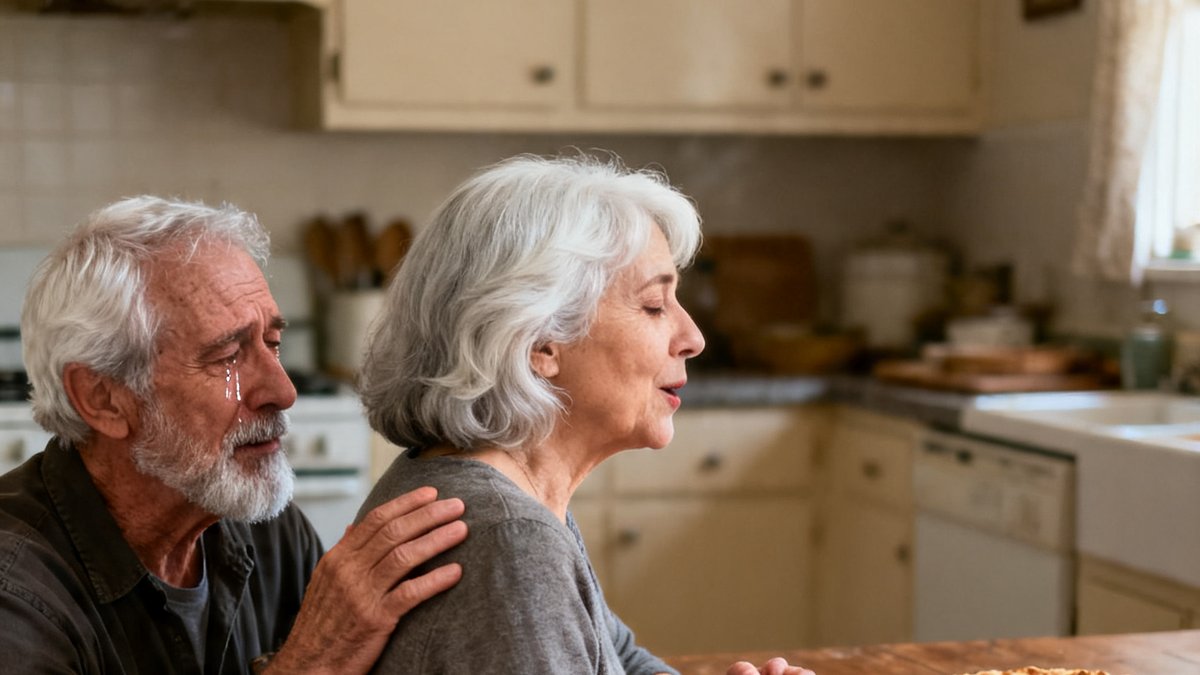
The kitchen smelled like a tire fire and regret. I stood there in my old Portland Fire Department hoodie, beating a dish towel against the smoke detector that wouldn’t quit, while my latest attempt at apple pie sat on the counter looking like a crime scene photo. The crust was black, the filling had bubbled over and welded itself to the pan, and a dusting of flour covered every surface in sight. This was pie number seven in six weeks, and I had yet to produce one that didn’t require a putty knife and a prayer.
I’m a man who spent three decades running toward things other people sprint away from. I’ve kicked down doors with flames licking my collar and pulled grown men out of third-story windows by their belt loops. Never broke a sweat. But ask me to roll out a simple circle of dough, and I’m reduced to a cursing, flour-covered mess.
Evelyn sat at the kitchen table, her hands folded neatly in her lap. She was watching me with a faraway smile, the one that meant she didn’t know my name today. But she knew the smell of cinnamon, and she knew this room was safe. That was enough.
For thirty-one years, Evelyn was the quiet engine of our family. While I was pulling seventy-hour weeks and sleeping in cramped firehouse bunks that smelled of diesel and old sweat, she was working the morning shift at the Bluebonnet Diner downtown. She never complained when I missed our anniversary because a warehouse fire turned into a three-day siege. She never made me feel like a heel when my radio squawked during our kids’ school plays or the few Sunday dinners we actually managed to sit down for.
What she gave me was a kind of love that doesn’t make headlines. I’d stumble home at four in the morning, my bones hollowed out, my turnout coat reeking of smoke and the metallic tang of things I didn’t want to talk about. I’d leave my heavy work boots by the back door, too exhausted to scrape off the soot and the grit. When I woke up a few hours later, those boots would be spotless. The blackened ash and the muck of the last call would be scrubbed away. Next to the coffee pot, wrapped in a clean dish towel, there was always a warm slice of apple pie. Not from the diner. Hers. Made from scratch, with a crust that flaked like tissue paper.
Evelyn never asked about the bad calls. She knew a man who spent his shift staring into the abyss needed two things: a clean pair of boots and something sweet to remind him he was home.
We raised three kids that way. The years rolled by in a blur of Little League games, college tuition checks, fire academy graduations, and the ever-present scent of cinnamon and woodsmoke. We always said we’d travel when I hung up my helmet. We pinned a map of New England to the laundry room wall and circled all the lighthouses we wanted to see. We were going to have time. All the time in the world.
But dementia doesn’t knock. It slips in through a crack no one sees.
It started with a forgotten burner, a pot of soup that boiled down to charcoal by the time I got home. Then she started misplacing the grandkids’ names. Then came the Tuesday I pulled into the driveway and found her standing barefoot in the slush, crying because she couldn’t remember which house was ours.
The doctors gave it a long, clinical name and showed me brain scans with shadows that looked like the dying coals of a fire I couldn’t put out. They handed me a stack of pamphlets that felt heavier than any report I’d ever filed. As a fire captain, I was trained to look at a problem, find the source, and hit it with everything I had. But there was no source here. No fire. No axe I could swing at it. My entire career had been about rescue, and I was utterly powerless against the slow theft of my wife’s mind.
So I walked into the chief’s office at Station 7 and handed over my badge. I traded my Nomex hood for an apron. My crew thought I’d lost my mind, walking away three years before my pension was fully baked. They said the city needed me. They didn’t understand. My only real responsibility now sat at a kitchen table with flour on her sleeve.
The transition was ugly. I burned the first six pies. I shattered her favorite mixing bowl. I locked myself in the garage one afternoon and wept into a pile of oily rags because I couldn’t get the dough to stop sticking. Then I dried my face and walked back inside because she was terrified of the shower and I was the only person who could coax her through it.
Slowly, I learned the rhythm. I learned to fold the butter into the flour without overworking it. I learned to brush her hair in small, gentle strokes when she grew frightened. I learned to watch her hands—when they started trembling and picking at the hem of her sweater, it was time to pour a cup of chamomile tea and put on the old Glenn Miller records.
Every evening now, I fill a basin with warm water and a few shakes of Epsom salts. I kneel on the braided rug in our living room, slip off her slippers, and wash her feet. I work the washcloth between her toes, careful with the bunions and the tender spots. I dry them with a towel that’s been warming on the radiator, then pull on her thick wool socks. That’s the most important rescue I’ve ever performed.
Yesterday was rough. She woke up agitated, pacing the hallway, calling for a mother who’s been gone since 1973. I didn’t correct her. I didn’t try to force her back onto the map of my reality. I just took her hand and led her to the kitchen. The oven timer dinged as we walked in. I pulled out a pie—not perfect, but the crust was golden and it smelled right. I cut a slice, blew on it until it wouldn’t burn her tongue, and placed the plate in her hands.
She took a bite. The panic drained from her eyes like a tide pulling back. She looked up at me. Really looked. First time all week.
“You have kind eyes,” she whispered, her voice thin as onion skin. “Are you a good man?”
My throat closed. I stood there in a kitchen that still smelled faintly of smoke and cinnamon, thirty years of grief and gratitude crowding my chest.
“I try to be,” I said. “I learned from the best.”
She smiled, nodded, and went back to humming a tune I couldn’t place.
Tonight, after I put her to bed, I’ll fill the basin again. I’ll kneel on the rug and wash the dust from her feet. It’s not the life we had planned, or the one we circled on any map. But here, in the quiet after the sirens have faded, I know it’s the most important shift I’ll ever work. True courage doesn’t always climb a ladder through smoke. Sometimes it just kneels down beside someone you love and washes their feet.