The call cut through my sleep like a razor. 5:08 a.m., July 14th. I fumbled for my phone, my heart already hammering. The voice on the other end was unnervingly calm, a woman with a soft Texas drawl.
“Ms. Miriam Cole? This is the Austin Police Department. We’ve located your daughter, Lena. She’s at the old Greyhound stop off Farm Road 812. There’s been an accident.”
My chest seized. Lena was five months pregnant and had told me she was staying at her husband’s place last night. That stop was a barren patch of concrete on the edge of town, notorious for nothing but dust and bad memories.
“Is she… is she breathing?” I was already out of bed, yanking on jeans, my feet bare.
“She’s alive. Bleeding. Paramedics are en route. We need you to meet them at Seton Medical.”
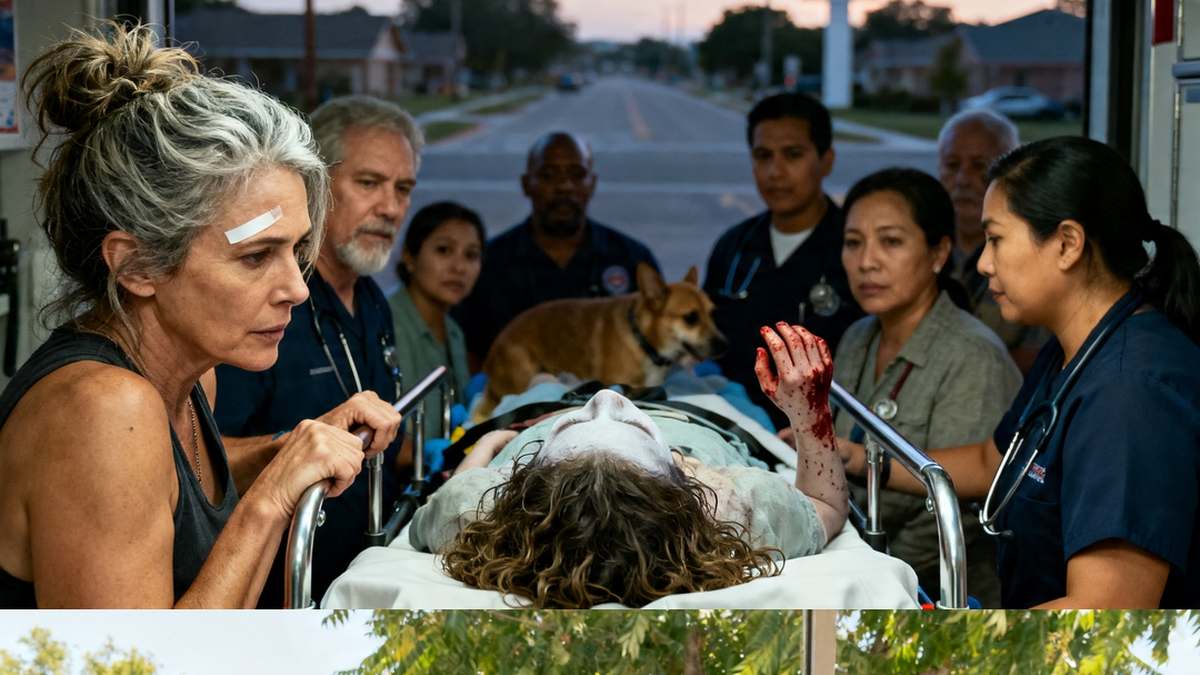
The line went dead. I don’t remember driving there. I remember running through the emergency room doors, and I remember the look on the sergeant’s face when he walked me toward the ambulance bay. Lena lay on a stretcher, her dark curls matted with something that looked black under the harsh lights. Her skin was chalk-white, her left arm bent at a grotesque angle. The paramedics were lifting her gently, but I saw the blood soaking through the gauze on her forehead.
I grabbed her cold hand. “Baby, I’m here. Can you hear me?”
Her eyelids fluttered. She was barely conscious, her breath shallow. Then her cracked lips moved, the sound so faint I had to press my ear to her mouth. One word.
“Colton.”
That single syllable punched a hole in my gut. Colton was her husband. The man who’d smiled at me so warmly at their wedding six months ago. The man who’d promised to protect her. The man who, according to every scrap of instinct I’d buried years ago, was supposed to be the reason I’d never have to use my old skills again.
I stayed in the waiting room, staring at my hands, until the double doors swung open and Colton himself strolled in. His face was a perfect mask of frantic grief. He practically threw himself at the nurse’s station, demanding to see his wife. I watched him from the corner. His voice cracked just right, his shoulders shook. But when he turned, fumbling for his phone, I saw it. A text notification flashed on the screen. The sender was “Mom.”
*Did it work?*
He deleted it with a swipe so practiced it was second nature. Then he looked up, met my eyes, and plastered on a look of tortured concern. His eyes were flat, like a cracked phone screen that still lit up.
No. I didn’t say a word. I just started counting the tiles on the floor, the way I used to when I was waiting for a mark to slip up.
Twenty minutes later, Dr. Shaw, the attending OB-GYN, pulled me aside. Her voice was measured, careful. “Lena’s stable, but she has a lacerated spleen, multiple rib fractures, and significant bruising across her torso. The pattern is… inconsistent with a simple fall. And her tox screen came back positive for a benzodiazepine—a heavy sedative she has no prescription for.”
I felt the linoleum tilt. Colton hovered nearby, his jaw tight. “That’s impossible,” he said, his voice suddenly sharp. “She’s just clumsy. The pregnancy has her stressed. Maybe she took something on her own.”
Dr. Shaw didn’t answer him. She looked only at me, her expression telling me she’d seen abused women before, and she’d already called social services.
That night, I dug a prepaid phone out of a locked box in my closet. I hadn’t touched it in eight years. Hell if I know why I still had that box. I dialed a number I knew by heart.
A gruff voice answered, heavy with smoke and something that sounded like a late-life regret. “Joe Santini. Who’s this?”
“Miriam. I need to cash in an old favor.”
Joe was a retired APD detective I’d worked with when I was a journalist, back when I didn’t just write about crime—I waded into it, buying information, trading secrets, making problems disappear for the right people. I’d left that life to raise Lena. Now I offered him $20,000 cash and a name: Colton Bennett.
Three days later, Joe met me in a diner off I-35. He slid a manila folder across the table, his eyes grim. “Your son-in-law and his daddy, Warren Bennett, are drowning. Their whole commercial real estate firm, ‘Riverbend Capital,’ is over five million in the hole. Bank’s about to foreclose on everything. And three months ago, Colton took out a two-million-dollar life insurance policy on Lena. He’s the sole beneficiary.”
The coffee in my mouth turned to acid. Joe wasn’t done.
“There’s more. Did Lena ever mention a great-aunt? An old woman named Geneva who ran a vintage vinyl shop on South Congress?”
I shook my head. Lena had mentioned an odd aunt once, years ago, but she’d died when Lena was little.
“Well,” Joe said, “Aunt Geneva passed away six weeks ago and left Lena the entire place—the shop *and* the historic building it’s in. Prime real estate. Worth about $1.3 million. Colton found out two weeks after the will was read. He’s been pressuring Lena to sign a power of attorney to ‘consolidate their assets.’ She was about to do it the day before she ended up bleeding on that bus stop bench.”
That was the angle. Colton didn’t just need money; he needed the building *now*, before the bank ate him. A dead wife meant a murder investigation, probate, and the insurance company poking around—a delay he couldn’t afford. But a wife laid up in a hospital bed, scared and grieving a lost pregnancy, she’d sign anything. The insurance was just the backup if he pushed too hard and she died anyway. That was his gamble. Push her down enough to break the baby, not the mother.
I walked out of that diner and spit into the parking lot dirt. He thought he was dealing with a retired newspaper editor who made casseroles and crosswords. He had no idea who I used to be.
My next call was to Simone, a hacker I’d once hired to expose a corrupt city councilman. She was brilliant, reclusive, and loved nothing more than a challenge. I offered her $25,000 and a promise of complete anonymity.
Within days, Simone had crafted a digital ghost—a sleek, fake identity as a “property investor” named “Eric Harlow.” She reached out to Colton through a commercial real estate forum, expressing interest in buying the South Congress building. Colton, arrogant and desperate, bit immediately. He figured he’d sell the property as soon as he got the POA, and a cash buyer in hand was manna from heaven. He started calling “Eric” to discuss the deal.
Simone recorded everything.
I sat next to Simone in her cramped apartment, headphones on, and listened. Colton’s voice, all salesman charm, then sliding into something greasy. He was trying to reassure the investor that the property would be unencumbered. “The current owner, my wife, she’s had a… uh, medical issue. A fall. But she’s gonna sign over power of attorney any day now. Once that clears, we can close fast.” Eric pushed: “What kind of fall? I can’t have legal hang-ups.” Colton laughed. “Come on, it was an accident. She’s at Seton Medical, but she’s fine. I just need you to be patient.” There it was. Not a full confession, but enough to connect the dots.
Simone also found his cloud backup. A deleted text chain with Warren from the night before: *She’s out cold. Taking her to the stop now.* And Warren’s reply: *Make it look good.* That was better.
I loaded the audio file and screen captures onto three separate encrypted drives and sent copies to Joe. But I needed more to break Lena free. Colton had isolated her completely in the hospital, sweet-talking the nurses, telling them my visits agitated her. I managed to see her for five minutes alone by sneaking in during a shift change. She looked at me with exhausted, guilty eyes.
“Mom, Colton says it was my fault—that I’ve been so forgetful, so clumsy. He says he’s just trying to take care of me.”
I showed her Joe’s folder first: the insurance policy, the debt statements, the property records. Then I pulled out the part that made me want to scream.
“Becca,” I said.
Becca was Lena’s best friend since middle school. She’d been the maid of honor at the wedding. She was also broke. Joe had found three cash payments totaling $10,000 from Colton’s account to Becca’s, right after the will was discovered. Becca had fed him every detail about Aunt Geneva’s inheritance, and she’d done it knowing he was desperate.
Lena flipped through the bank statements. She stared at the photo of Colton and Becca having coffee, timestamped two days before her “accident.” Her face went blank—no tears, just a stillness that scared me more. Then she picked up her phone from the nightstand. I heard the dial tone. It rang, and rang, then voicemail. She didn’t leave a message. She just hung up, pulled up her contacts, and blocked the number. Not a word. That was the end of Becca.
She set the phone down. “He wanted to kill my baby.”
“Yes.”
“Then let’s end him.”
Three hours later, we had a lawyer, a court order, and Joe Santini standing guard outside her room. The plan was simple: call Colton in, hit him with the evidence, and see if he’d bolt. He’d either flip on his father or run straight to Warren. Either way, we’d have our reaction.
When Colton arrived that afternoon with a bouquet of roses and a practiced smile, he walked into a trap. Me, Joe, the lawyer, and Lena, sitting up in bed with a tablet displaying the insurance document. I hit play on a small speaker. His own voice filled the room, talking to “Eric”: *“…she’s had a medical issue. A fall. But she’s gonna sign over power of attorney any day now.”*
Colton’s face slackened. He turned the color of old oatmeal. He threw the roses at the floor, called me a manipulative witch, and bolted. Joe didn’t stop him. I already had Joe’s camera phone running, catching every second for the DA.
That night, I knew Warren would strike back. By morning, a local crime blog had posted a hatchet piece: *“Mother of ‘Victim’ Was an Underworld Fixer.”* It detailed my past, the cash exchanges, the shadowy network. The byline was a ghost, but the source was Warren Bennett, trying to bury me in scandal.
He miscalculated. Simone had also been working on Warren. She’d found a trail of offshore accounts and shell companies funneling money from Riverbend Capital into dummy ventures in the Caymans. I had enough to bury the whole family.
I took everything—the audio snippet, the text logs, the insurance, and Warren’s money-laundering proof—to a producer I knew at a national news network. They ran a story that evening, but not without a fight. Warren’s lawyer filed an emergency motion to block the broadcast, claiming the recordings were illegally obtained. For three hours, we sat in my kitchen, watching the producer pace, waiting for a judge’s call. At 9:42 p.m., the station’s legal team cleared it. The audio went out, along with the bank records.
Warren’s smear job backfired so spectacularly that his own business partners started leaking more damning files. My phone rang. It was Warren, his voice no longer booming with Texas charm. He offered me $500,000 cash to say the audio was fabricated. I told him I had a better idea: I’d already given the FBI his Cayman routing numbers. He hung up so hard I heard plastic crack.
Colton was arrested at a motel in San Marcos two hours later, after a minor scuffle in the parking lot. Warren was taken into custody at his office the next morning. Lena filed for divorce from her hospital bed and signed an emergency order to reclaim full control of her inheritance.
It’s been eight months. Lena’s son, a healthy boy with her dark curls, sleeps in a crib that we set up in the old apartment above the vinyl shop. The building’s brick walls hum with music again, the shop downstairs newly reopened. Lena put a hand-lettered sign in the window: “Temporarily Closed for Repairs—To the World, and to Me.” She crossed out “Temporarily” a week later.
I still have that prepaid phone in a drawer. I haven’t made a call on it in months, but I keep it charged. Sometimes, late at night, I walk past the nursery doorway. I hear her singing a lullaby, a little off-key, the same three lines over and over. The floorboard by the door creaks. She stops for a second. I don’t open it. The singing starts again, steadier this time.