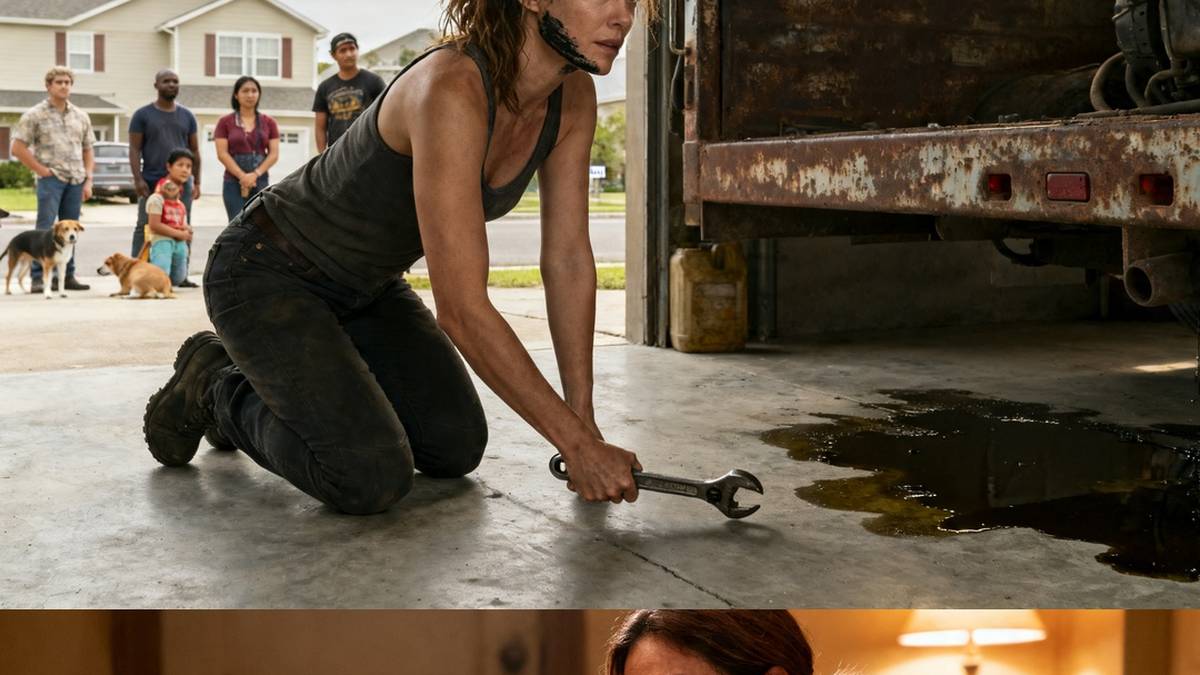
The wrench slipped for the third time. I was kneeling on the cold concrete of my father’s garage, a pool of stale oil spreading toward my jeans, and the old Ford Ranger still wasn’t giving up its fuel filter. Leo sat on a wooden crate nearby, a half-built model car in his lap, watching me with the mild, untethered curiosity of a man who had long stopped recognizing his own tools. He didn’t know my name this morning—he’d called me “miss” when I helped him out of bed—but something in the bite of transmission fluid and engine grit seemed to settle him. This garage was his cathedral, and for a few hours, he was still the high priest.
I am forty-two years old. For the last fourteen of those years, I was a project manager for a tech firm in San Jose, commuting an hour each way from a condo in San Francisco, the kind of woman who could juggle twelve deadlines on three hours of sleep and a cold latte. I negotiated million-dollar contracts, flew cross-country twice a month, and considered a delayed reply to a paternal voicemail a reasonable sacrifice for a promotion. But on a Tuesday in March, I walked into my corner office in San Jose, dropped my resignation letter on my boss’s desk, and traded my quarterly reviews for a pair of steel-toed boots and a crumbling farmhouse in rural Pennsylvania. Because the man who had quietly held my world together for three decades was now losing his grip on his own.
My mother died of an aneurysm when I was ten. Leo Keenan raised me alone while running a two-bay auto shop and baking hand pies for the diner on Route 6. He woke at four every morning, not to pray or meditate, but to check the fluids in my battered Chevy Cavalier so it wouldn’t strand me on the way to school. He’d fill the tires, top off the wiper fluid, and leave a warm cherry turnover wrapped in wax paper on the passenger seat. Tucked under it, a torn piece of receipt paper with a single line: *Drive safe, kiddo*, written in the same grease pencil he used for repair tickets.
He showed up to every ballet recital in the community center gym, standing in the back because his coveralls still carried the ghost of motor oil and industrial degreaser. He clapped so hard I could hear the echo over the tinned music, even when I fumbled a pirouette. When I got a full ride to Stanford, he drove me across the country in that same Cavalier, a cooler of sandwiches and chocolate milk between us, never once mentioning that he’d sold his only motorcycle to buy my dorm bedding and a used laptop. That was Leo. The man never gave me a single speech about sacrifice. He just tightened the bolts, wiped the grease, and showed up.
College became a career, and a career became a whirlwind that left him as a voice on my phone every other Sunday. I’d promise to visit for Thanksgiving, then cancel for a launch. I’d call on his birthday, but from an airport lounge halfway through a margarita. He never complained. He’d just say, “Got enough oil in your rig?” and I’d laugh, not realizing he was asking the only way he knew how if I was still okay.
The call came from his neighbor, a retired nurse named Gloria. She’d found him standing in his driveway at two in the morning, wearing his bathrobe and holding a tire iron, insisting he needed to change the snow tires before his daughter’s drive to school. I was thirty-seven. It was July. I flew out that night.
The neurologist in Wilkes-Barre used words like “early-onset Alzheimer’s” and “accelerated progression.” The brain scans looked like a patch of December frost slowly swallowing the edges of a green field. I sat in that office in my six-hundred-dollar heels, and while the doctor talked about plaques and proteins, I fixated on a scuff mark on the linoleum floor, shaped like a crescent moon. I remembered my dad once fixing the alternator in a Kmart parking lot with a borrowed crescent wrench so I wouldn’t miss the homecoming parade. I was a woman who solved problems. I demanded a timeline, a treatment, a spreadsheet of next steps—anything I could check off and control. The doctor just handed me a thick folder and said, “Arrange for full-time care. He’s going to need more than one person can give.”
I didn’t listen. I flew him out to San Francisco that same month, put him in my guest room, and hired a daytime aide while I commuted to San Jose. For a while, I fooled myself into thinking I could manage with phone check-ins and weekend care. But the aides came and went like seasonal workers. The first one quit after he dismantled the bathroom faucet so completely we needed a plumber. The second lasted six weeks before he walked out the front door while she was on a call with her mother. I had a plastic folder of emergency contacts, a neighbor named Theresa who cooked him dinner when I was on a late call, and a boss who let me remote in two days a week—but every time my cell buzzed with a 415 area code during a meeting, my stomach clenched. I’d gun the engine across the Bay Bridge, cursing the traffic, and find him in the lobby holding someone’s dry cleaning, or sitting on a planter, convinced he was waiting for the school bus.
This went on for five years. I hired a half-dozen aides, blew through thirty thousand dollars of savings, and still couldn’t stop the slide. By the time I turned forty-two, the light in his eyes had turned watery and thin, and I was running on fumes. The last aide handed me a typed resignation letter and said, “He needs family.” So I sold the condo in San Francisco. Every stick of furniture, every corporate award, every framed photo of networking galas and handshake deals—gone in a weekend estate sale. I packed his old Ranger with a suitcase apiece and drove us back east, back to the house with the tin roof and the wide willow tree he planted the year I was born. I told myself I’d figure out a plan. I was a master of contingency charts. But the truth was, I had no map for this.
The first month was a slow-motion disaster. I tried to maintain a routine, but I didn’t know how to cook anything that came from a box, let alone his mother’s pantry recipes. I burned the first three attempts at apple pie, filling the kitchen with acrid smoke while Leo sat on the porch, humming an Irish folk tune I didn’t recognize. I lost my patience when he refused to bathe, and then I sobbed in the garage, my forehead pressed against the cold metal of his workbench, furious at myself for not knowing how to gently wash a grown man who once carried me on his shoulders.
Slowly, I surrendered my need for control. I stopped correcting him when he called me by my mother’s name, or when he asked where the horses were. There were no horses; there never had been. I started sitting with him in the garage, handing him wrenches even if he just spun them in his fingers. I discovered that the smell of fresh gasoline could bring a lucid light to his eyes for a few minutes, and that oatmeal was the only breakfast he’d eat without a fight.
One evening, I was scrubbing engine grease off my hands with the same gritty hand soap from a tin that had sat by his shop sink forever—Granddad’s stuff, must have been forty years old—and I caught a whiff of cherries. I went back into the kitchen. The fourth pie was cooling on the counter, almost edible. I cut a slice, and for a second I was ten years old, watching him shimmy out from under a car and hand me a turnover. I sat on the porch step, the plate warm on my knees, and listened to him hum that nameless tune. That was when I understood, not with my brain but with the ache in my chest, that his love had always looked like a preset torque wrench and a midnight tire rotation and the lunch he packed that I threw away because I wanted Pizza Hut.
Yesterday morning was brutal. He woke confused and combative, convinced I was a stranger who had stolen his wallet. He shoved a kitchen chair, sent the cornflakes flying, and backed himself into a corner with a wild, terrified look. I didn’t touch him. I didn’t sweep up the mess. I just sat on the floor, crossed my legs, and started talking casually about the old Ranger, about how stubborn the carburetor was, how I could use his help later. I didn’t even know if he remembered the truck, but the cadence of engine talk seemed to hold him. Within ten minutes, the storm passed, and he let me guide him to the armchair.
That evening, I filled a basin with warm water and a little chamomile soap—$3.99 at the drugstore, I’d bought it because the box said “calming” and I was desperate. I knelt on the linoleum, lifted his worn slippers off, and submerged his feet. He wasn’t agitated at all—he just watched my movements with a kind of abstract wonder, the way a child watches a goldfish swim. I dried each foot with a towel that still had his shop’s faded logo, and I thought of the countless times his own hands, cracked from hard winters, had scrubbed the dirt from my ballet slippers after recitals because I was too tired to do it myself.
As I pulled on his thick wool socks, he suddenly leaned forward and looked at me with a startling clarity. His eyes were that same deep hazel I remembered from childhood, the ones that always saw right through any lie I tried to sell about being fine.
“You have gentle hands,” he said, his voice rough but steady. “Do I know you from somewhere?”
The lump in my throat was painful. I smoothed the sock over his heel and said, “Yeah, Dad. You’ve known me my whole life.”
He nodded, not quite understanding but accepting it. “Good,” he murmured. “You remind me of my daughter. She’s going to be president someday, you know.”
I managed a smile. “I’m sure she learned from the best.”
He dozed off a few minutes later, and I sat on the floor next to his chair, listening to the crickets outside and the old wall clock ticking. The farmhouse creaked around us, the same creaks I used to hear when I was ten and terrified of the dark, and the same soft rhythm of his snoring that promised safety until morning.
This morning, I brought him a slice of apple pie fresh from the oven, his mother’s recipe finally not burned. He sat by the window, the model car kit half-assembled in his lap, the birds in the willow tree busy at the feeder. I put the plate in his hands, and he took a bite without looking at me, a small, peaceful hum escaping his lips.
I walked back out to the garage. The wrench was where I’d kicked it earlier, under the passenger-side tire. I picked it up, wiped the oil off on my sleeve, and laid it on the workbench. The fuel filter was still half-off. I’d get to it tomorrow. I looked through the open doors—my father sat in the window light, a silvered outline, humming that tune I’d never learned the name of. The willow branches rustled with the last of the autumn light. I stood in the doorway until the garage turned orange and blue, the smell of apples and old oil mixing in the air, and then I went back inside to make sure he’d eaten his pie.