Martha found out on a Tuesday afternoon in a sterile clinic in Des Moines. The doctor, a young woman with kind eyes and a tragic haircut, looked up from the file and delivered the news not like a death sentence, but like a weather report. Severe endometriosis. Scarring. The chances of carrying a child to term were astronomically low.
Martha didn’t cry in the office. She walked out into the parking lot, the Iowa sun bleaching the asphalt a blinding white. A semi-truck roared past on the interstate, shaking the ground. Inside her, a door slammed shut. Not with a bang, but with a slick, hydraulic hiss that was infinitely worse.
Walter came home that night with grease still under his fingernails from the auto shop. He found her sitting on the back porch, staring at the cornfields. He didn’t say a word. He just sat down, pulled off his John Deere cap, and placed his heavy, calloused hand on the back of her neck. They stayed like that until the mosquitos drove them inside.
They tried to fill the silence for five years. Walter fixed transmissions. Martha worked the circulation desk at the town library. They bought a slightly used sedan, repainted the living room a soft grey, and slept back-to-back in a queen-sized bed. But the house on the edge of Booneville had three bedrooms, and two of them stood empty, collecting dust motes and an echoing silence that mocked the ticking clock in the hallway.
The idea hit Martha not like a lightning bolt, but like a slow, creeping vine. She saw a flyer at the library for a foster care information session. She didn’t tell Walter at first. She just went. Then she went again. The social workers talked about trauma, attachment disorders, and the desperate need for homes for sibling groups. Not babies. Older kids. The ones nobody wanted.
“I want to look into adoption,” she finally said over meatloaf one night.
Walter chewed slowly, swallowed, and took a sip of beer. “Okay. A baby?”
“No,” Martha said. “Not a baby. Maybe… a few of them. Siblings.”
The silence that followed was thick enough to slice. Walter looked at her like she’d suggested they buy a spaceship. “A few? Martha, we can barely afford the transmission rebuild on the Impala.”
“I don’t mean six, Walt. I just… I want to look.”
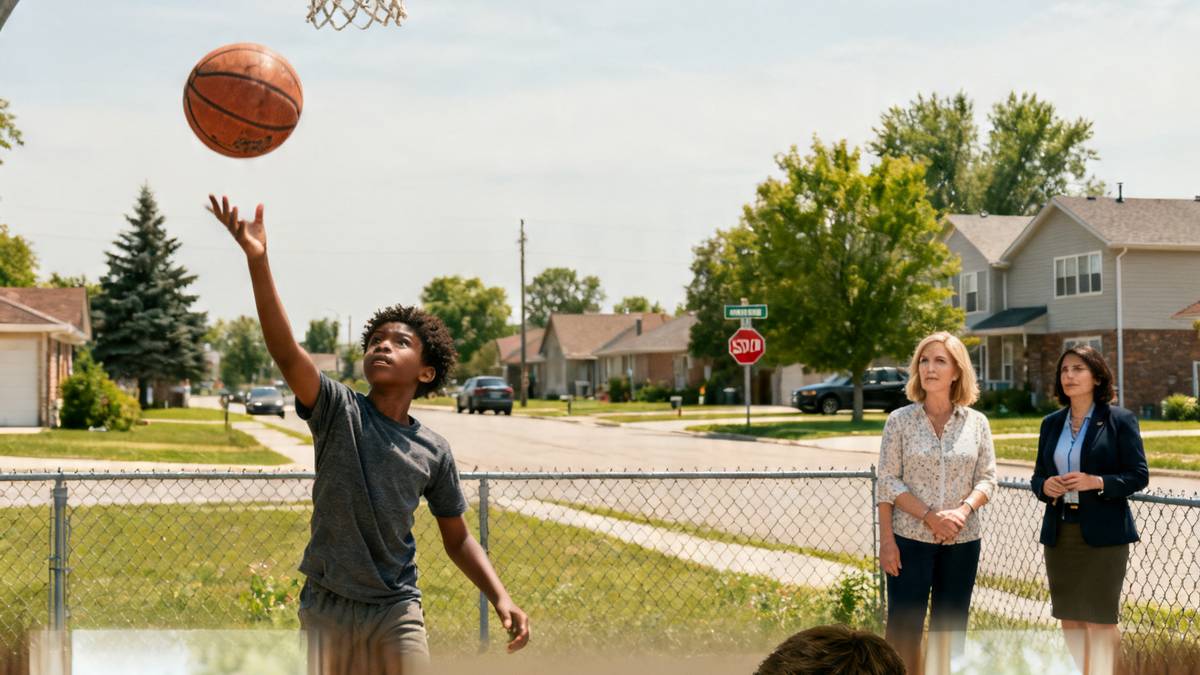
They toured a group home in Council Bluffs. The building was a sprawling ranch-style house that smelled of bleach and desperation. In the backyard, a scrawny boy of about nine was hurling a deflated basketball at a bent rim. He missed every time and swore under his breath each time he chased the ball. Inside, a social worker pointed out a pair glued to a threadbare sofa—a girl, maybe six, with wire-rimmed glasses, reading a picture book to a much smaller boy. He was swimming in a too-large t-shirt, his thumb planted firmly in his mouth.
Martha’s eyes, however, kept drifting back to the angry kid on the court. “What about him?” she asked.
“Ah, that’s Derek. Age eleven,” the social worker sighed. “Smart as a whip, but a history of aggression. Defensive. He’s been here the longest. Nobody wants a kid who throws fists first.”
“And those two on the couch?” Martha pointed.
“Molly and Sam. Sister and half-brother. They’re a package deal. Just got placed here last month. Sweet kids, but terrified. They won’t talk to anyone but each other.”
Martha watched as Derek, the angry one, finally gave up on the hoop. He walked past the couch. The little boy, Sam, pulled his thumb out of his mouth and held up the picture book. Derek stopped. He ruffled Sam’s hair, a surprisingly gentle gesture, and pointed at the dinosaur. “T-Rex,” he grunted. “King of the killers.”
Then he glanced up and caught Martha staring. His black eyes were hard, like chips of obsidian. “What are you looking at?” he snapped.
Martha turned to the social worker. “I want all three of them.”
The social worker choked on her coffee. Walter, standing behind Martha, dropped the keys to the Impala. “All of them?” he sputtered. “Martha, that’s three. Three kids. We don’t know the first thing about parenting!”
“Nobody does, Walt. We’ll learn.”
The home study process was brutal. It was months of invading their financial privacy, probing their marriage, and inspecting the old farmhouse for safety hazards. Martha weaponized stubbornness. She installed safety gates, fire extinguishers, and outlet covers with the ferocity of a general fortifying a base. Walter, seeing the set of her jaw, just quietly fixed the rickety stair railing and built a bunk bed for the boys’ room.
When the kids arrived, the town of Booneville acted like a scandal had landed on their doorstep. Mrs. Henderson from down the lane stood by her mailbox, arms crossed. “Martha, are you out of your cotton-picking mind?” she hollered. “You can’t fix broken kids. They’ll rob you blind and run off the second they’re eighteen. Blood runs thicker than water, honey.”
Martha ignored her. She walked the kids up the steps. Derek looked ready to bolt. Molly held Sam’s hand so tight her knuckles were white.
The first night was a disaster. Sam cried for three hours, a high-pitched, keening wail that cut right through the walls. Molly sat rigidly in bed, refusing to lie down, as if she was waiting for an ambush. Derek was nowhere to be found. Walter found him eventually, sitting in the dark on the roof of the Impala, staring at the stars.
“You gonna run?” Walter asked, climbing up next to him with a grunt.
“Where would I run to?” Derek scoffed. “This is just another stop before you send me back. I broke a window at the last place. I’ll probably break something here.”
Walter nodded slowly. “Martha just bought new windows. They were expensive. If you break one, you’re gonna work it off in the shop with me. I got a ’79 Trans Am that needs sanding. Lots of sanding.”
Derek looked at him, a flicker of confusion replacing the anger. “You’re not gonna hit me?”
“Son, I’m too tired to hit you,” Walter said, his voice gravelly but not unkind. “And I don’t break things I’m trying to fix.”
That was the turning point.
Life became a logistical nightmare of epic proportions. Martha quit the library and took a higher-paying job at the county records office, processing titles and deeds. The work was soul-crushingly boring, but the benefits were good. Walter worked overtime at the shop until his back screamed. The house became a blur of muddy sneakers, math homework, and massive pots of chili. Derek got suspended from Booneville Middle School in the second week for decking a kid who called Molly “orphan scum.”
Martha sat in the principal's office, a grim-faced man in a cheap suit shaking his head. “We have a zero-tolerance policy.”
“And I have a zero-tolerance policy for bullies,” Martha replied, her voice deceptively calm. “If your staff can’t keep a traumatized girl from being harassed, my boy will handle it. Now, are we discussing suspension or the failure of your supervision?”
The principal blinked. The suspension was reduced to a day. On the way home, Martha looked at Derek in the rearview mirror. He was sinking into the seat, expecting a storm. “What you did was stupid and violent,” she said. “But I’m proud you protected your sister. Next time, find an adult. If you can’t find one, hit harder.”
A tiny, crooked grin cracked Derek’s face. “Okay, Ma.”
The word ‘Ma’ hung in the air of the Impala like a rare, precious gem.
Years dissolved like sugar in hot coffee. Molly turned out to be a certified genius, though her anxiety meant she’d hyperventilate before every exam. Martha would sit on the bathroom floor with her, holding a wet washcloth and coaching her breathing. Sam, the baby, was a gentle giant who grew nine inches in two years and could eat a whole chicken in one sitting. He started calling Walter “Pops” and followed him around the garage like a shadow, learning the difference between a socket wrench and an Allen key. Derek, all lanky limbs and simmering intensity, channeled his rage into football. He became a defensive tackle, a human wall. College scouts started showing up to the Friday night games.
Through it all, the house groaned and shifted. The roof in the sunroom leaked into a bucket. The furnace died every February without fail. The porch was slanting at a dangerous angle.
One Christmas, the kids, now practically adults, sat Martha and Walter down on the lumpy floral sofa. Derek, now a junior at Iowa State, stood with his arms crossed. Molly, in her scrubs from nursing clinicals, held a manila folder. Sam, still a high school senior, fiddled with his phone nervously.
“Mom, Dad,” Molly started, her voice quivering with emotion. “We’ve been talking.”
“We’re taking down this death trap,” Derek finished bluntly.
Martha frowned. “Excuse me?”
Sam opened his phone and turned it around. It was a rendering of a beautiful, modern farmhouse. A wraparound porch. A metal roof. Huge windows. “We got pre-approved for a construction loan,” Sam said. “Derek’s doing the engineering oversight. I’m doing the landscaping. Molly’s managing the budget. You two are going to live in a house that doesn’t require a bucket in the sunroom.”
“You can’t do this,” Martha whispered, her hands flying to her mouth. “This is… where is the money coming from? You’re kids!”
“You worked double shifts to pay for my physical therapy when I broke my femur,” Derek said, his voice raspy. “You emptied your 401k so Molly could go to nursing school. You gave us everything. You think we’d let you rot in a house that could collapse in a nor’easter? Forget it, Ma. We’re building it. You can help pick the paint, but the foundation’s being poured in April.”
Martha cried. She was a stoic woman, a librarian who didn’t tolerate noise, but she sobbed so hard Walter had to hold her up.
The demolition and construction became a community spectacle. The dingy, white clapboard house that had been the Hendersons’ shame was peeled away, replaced by a skeleton of engineered wood. The kids came back every single weekend. Derek stomped around in a hard hat, a blueprint tube in his hand, cursing at the suppliers. Molly showed up with a first-aid kit and healthy breakfast burritos for the crew. Sam, strong as an ox, hauled lumber and dug trenches alongside his friends from the high school football team.
The day of the roof-raising, Mrs. Henderson walked over from next door. She was ancient now, using a walker, her own son long gone from Booneville, holed up somewhere in Arizona dodging ex-wives and debt collectors. She stopped at the edge of the yard and just stared at the massive, sturdy new structure rising against the Iowa sky. The new house had a porch with a porch swing. It had a chimney for a wood-burning stove. It was the kind of house you see in magazines about simple, honest country living.
Martha saw her and walked over. The air smelled of fresh-cut pine and sawdust.
“Hello, Evelyn,” Martha said softly.
“Martha,” the old woman croaked. Tears were leaking from her rheumy eyes. “I was wrong. All those years ago. I was so wrong. My own flesh and blood left me to rot, like you said.”
“I never said that, Evelyn.”
“You thought it. You’d have a right to.” Mrs. Henderson looked at the new house, the symbol of a family stitched together by sheer will. “They did this for you. Your kids. The ones you chose. I chose blood, and look at me. Dying alone in a house that’s falling down just like I am.”
Martha could have felt vindication. She felt only a hollow sadness. She reached out and touched the old woman’s thin, papery hand. “Come over for supper tonight, Evelyn. We’re just grilling hot dogs out back, but there’s plenty.”
Mrs. Henderson broke down, a dry, rasping sob escaping her lips. “I don’t deserve it.”
“Nobody does,” Martha said softly. “That’s the whole point.”
They moved into the new house on a bright Saturday in June. The place smelled of fresh paint and wood varnish. Walter, now retired, sat on the brand-new wraparound porch, carving a piece of driftwood. He looked twenty years younger. Martha was inside, arranging her grandmother’s china in a hutch that had been built specifically to hold it.
That evening, the kids were scattered across the great room. Derek was arguing with a drafting tablet, running calculations for a bridge project in Omaha. Molly was curled up on a deep sectional sofa, reading a medical journal. Sam was out on the lawn, throwing a football for a golden retriever puppy he’d just adopted.
Martha stood in the doorway of the kitchen, a dish towel over her shoulder, looking at them. The house was quiet except for the hum of the new fridge and the click of Derek’s stylus. It was a silence filled with breathing. With presence. With the absolute, unshakeable architecture of belonging.
Derek glanced up, sensing her gaze. “What?”
“Nothing,” she said, her voice thick. “Just… dinner’s in an hour. Lasagna.”
“The one with the spinach?” Molly asked without looking up from her journal. “I’ve been thinking about that all week.”
“Best in Iowa,” Walter grunted from the porch, his voice floating through the open window. “Your mother is a miracle worker.”
Martha turned back into the kitchen. On the windowsill above the sink was a small, framed photograph. It was the first picture ever taken of the family. A surly eleven-year-old with a shiner standing stiffly next to a terrified six-year-old and a four-year-old with a thumb in his mouth. Two exhausted, middle-aged strangers flanked them, wearing clothes from a thrift shop and expressions of pure panic.
She looked at the photo, then out the window at the sprawling, healthy lawn where Sam was teaching the dog to sit, the dog completely ignoring him, tail wagging in chaotic, redundant circles.
The road to this kitchen had been paved with insomnia, terror, and three thousand loads of laundry. But the house was warm, the roof was solid, and the sound of her children—her chosen children—filled every corner. She knew the saying. Blood is thicker than water.
But she had learned, looking at that golden light pooling on the new oak floors, that the full saying was actually: *The blood of the covenant is thicker than the water of the womb.*
And covenants, she thought, picking up a knife to chop garlic, were not inherited. They were built. Nail by nail, meal by meal, moment by stubborn, furious, desperate moment of grace.